

The Wedge-Disc Principle – The Technology Behind the MULTICRACKER®
Efficient Grinding based on a Unique Grinding Principle
The performance of a grinding machine is not determined solely by motor power or physical size. What matters most is the underlying grinding principle. While many industrial applications use hammer mills, roller mills, or grain crushers, the MULTICRACKER® is based on the wedge-disc principle – a distinct process designed for controlled material guidance and particularly efficient use of input energy.
This principle produces homogeneous grinding results, minimal fines, and economical energy use. The technology forms the foundation of all MULTICRACKER® machines and has proven itself worldwide in a wide range of applications in the feed, food, agriculture, chemical, and process industries.
Innovative Size Reduction Technology
Our MULTICRACKER® machines were developed based on nature’s model with the goal of achieving the most efficient and effective size reduction of bulk materials. The focus is not on the highest possible impact energy, but on targeted and controlled application of forces to the material. The result is an energy-efficient size reduction process with uniform particle size distribution and gentle product handling.
From Grinding Principle to Wedge-Disc Mill
Our MULTICRACKER® grinding technology is based on the wedge-disc mill principle. Unlike conventional milling systems, grinding does not occur primarily through impact stress or between smooth rollers. Instead, the material is guided in a controlled manner between two specially profiled wedge discs. These capture the raw material, draw it evenly into the grinding gap, and generate defined compression, shear, and friction forces.
The targeted material guidance ensures that the input energy is used directly for size reduction. This produces reproducible results with low energy consumption and particularly homogeneous particle size distribution.
Advantages Over a Hammer Mill
Hammer mills are among the most commonly used size reduction systems. Their operating principle is based primarily on rapidly rotating impact tools that repeatedly throw the material against impact surfaces and screens. This method is universally applicable, but – depending on the material – often produces a higher proportion of fines, greater dust generation, and a wider range of particle sizes. At the same time, a significant portion of the input energy is used for repeated impacts and air movement within the grinding chamber.
The MULTICRACKER® wedge-disc mill takes a different approach. Through targeted material guidance between the cracker discs, the grinding energy is applied directly where it is needed. The result is more homogeneous ground material, reduced fines, and significantly lower specific energy consumption. At the same time, processing is particularly gentle, which can improve the quality of the final product and the efficiency of downstream processes.
More Compact Than a Roller Mill
Roller mills are considered a proven solution when uniform size reduction with defined particle sizes is required. However, to achieve high throughput rates, they require large roller diameters and correspondingly wide grinding mechanisms. This results in comparatively high space requirements and a more complex machine design.
The wedge-disc principle achieves comparable grinding performance in a significantly smaller footprint. In terms of throughput capacity, degree of size reduction, and service life, a MULTICRACKER® corresponds to a roller mill with grinding tools approximately twice as wide and a roller diameter roughly 1.8 times larger. This allows to achieve high performance with a much more compact machine.
More Precise Than a Grain Crusher
Especially in agriculture, grain crushers are often used for processing grain. These typically work with smooth or simply structured rollers and offer only limited options for specifically influencing the size reduction result.
The MULTICRACKER® goes significantly further. Even the smallest models feature profiled cracker discs and a precisely adjustable grinding gap. This allows grain size and degree of grinding to be precisely adapted to the respective raw material and desired application. This ensures reproducible results – from on-farm feed production to industrial continuous operation.
The Cracker Discs – The Heart of the MULTICRACKER®
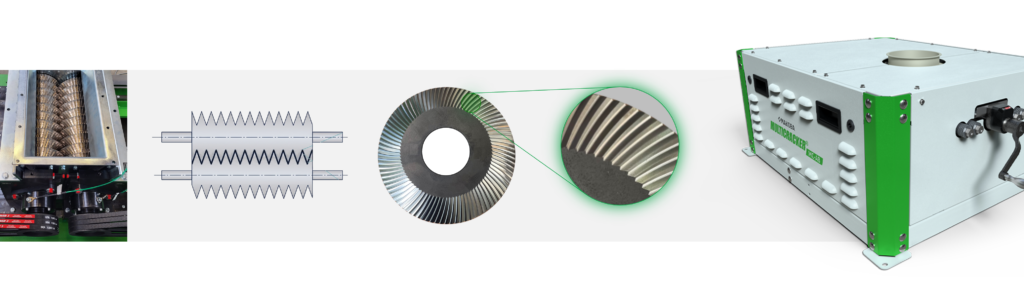
The actual heart of every MULTICRACKER® machine is the specially developed cracker discs. They put the wedge-disc principle into practice and largely determine the quality of the size reduction result.
All cracker discs feature a patented grinding profile that captures the raw material in a controlled manner, draws it in reliably, and grinds it uniformly. For most applications, three proven standard profiles are available: coarse, medium, and fine. These already cover a very broad range of applications and deliver excellent results in a wide variety of industries.
For special materials or specific process requirements, MAKOBA also develops custom profiles. Upon request, geometry and profile can be specifically adapted to the respective raw material to further optimize the size reduction result. This creates not a standard machine, but a size reduction solution precisely tailored to the specific application.
Patented Technology – Made in Germany
The cracker discs of the MULTICRACKER® are patented and form the foundation of our machines’ exceptional performance. Development, design, and manufacturing are carried out entirely in Germany. This gives our customers the benefit of high manufacturing quality, short communication channels, and long-term spare parts supply and technical support.
Developing the Right Solution Together
Every raw material has its own grinding requirements. That is why we not only advise you on selecting the right machine, but work with you to develop the optimal combination of cracker disc profile, grinding gap, and process parameters.
We are happy to conduct grinding trials with your original products and determine the most economical solution for your application under real conditions.
Speak with our experts or arrange a grinding trial with your product.
Your Advantages When You Use MULTICRACKER®
- Wedge-disc principle for small dimensions and low weight while achieving high throughput volume and excellent feed behavior
- Maximum energy efficiency for minimal energy use. Example: Energy consumption for corn for laying hens ~ 1 kWh
- Homogeneous grain size and minimal fines in the size reduction result
- Continuously adjustable grinding gap for flexible application range
- Low wear costs. Example: Laying hen feed with MC600 only approx. €0.10 per ton
- Cold cut, no heating of the material for gentle, efficient processing of valuable raw materials
- Different grinding profiles for wide range of applications
- Machines with ATEX certification available
- Integration into new or existing systems and system controls possible
Awards
Due to its innovative technology and unique advantages, the MULTICRACKER® has already received multiple awards
FAQ
Every Multicracker is based on the wedge-disc principle. The material is fed in at the top, passes through the gap, and is reduced in size in a single pass by the cracker discs and discharged at the bottom. Due to the special features of the wedge-disc principle, compared to a roller mill, this results in a compact design, good feed behavior, and a high degree of size reduction, and compared to a hammer mill, homogeneous grinding results, low energy consumption, and low dust generation. For very high degrees of size reduction, multi-stage systems are recommended.
A wedge-disc mill (wedge-shaped disc mill) consists of a pair of counter-rotating tool rollers made up of stacks of wedge-shaped discs. These have a surface profile with adjustable gap width. Unlike a roller mill, this creates not a straight grinding gap, but a zigzag-shaped one. The grinding rollers of a wedge-disc mill are usually driven at the same speed, since the shape and arrangement of the wedge discs always create relative velocity between the surfaces in the grinding gap.
Compared to the hammer mill, the solution is characterized by a narrower particle size distribution and significantly lower dust generation. At the same time, quiet operation provides more pleasant working conditions, while energy consumption can be reduced by up to 80%.
Grain crushers work on the roller mill principle and are much simpler in design, usually with a fixed grinding gap. Compared to a crusher, a MULTICRACKER of the same size offers significantly higher throughput and, thanks to the freely adjustable grinding gap, a more flexible range of applications.
Compared to a roller mill, a wedge-disc grinder with the same drive power and comparable volumetric throughput has the following advantages:
- Compact design
- Large working surface
- Large effective diameter and therefore good feed behavior
- Relative velocity of the surfaces
Due to the shape and arrangement of the wedge discs, the grinding gap and the effective disc diameter—and thus the working surface—of a wedge-disc grinding mechanism are larger than those of a grinding mechanism with cylindrical rollers.
Consequently, depending on the selected wedge disc angle, a wedge-disc mill acts on the ground material like a roller mill that is larger by a certain factor. The grinding mechanism of a MULTICRACKER® grinding machine, which has a wedge disc angle of 60 degrees, achieves approximately three times the throughput of a roller mill with cylindrical rollers at the same size.
In a roller mill the grinding gap is linear and the gap length is correspondent to the width of cylindrical rollers b that create the grinding gap.
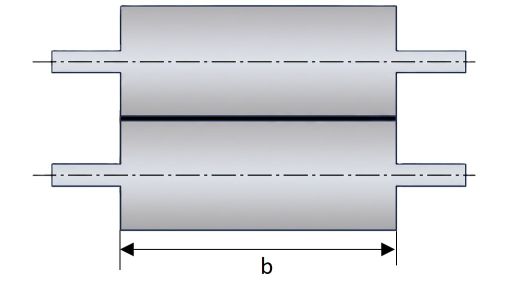
In a wedge-disc mill, the grinding gap is formed by the wedge discs and creates a serrated line. This has a length that corresponds to the width of the wedge-disc rollers b multiplied by a factor depending on the wedge angle. At a wedge angle of β = 60°, the grinding gap is twice as wide as the width of the wedge-disc rollers; at a wedge angle of β = 43°, it is three times as large.
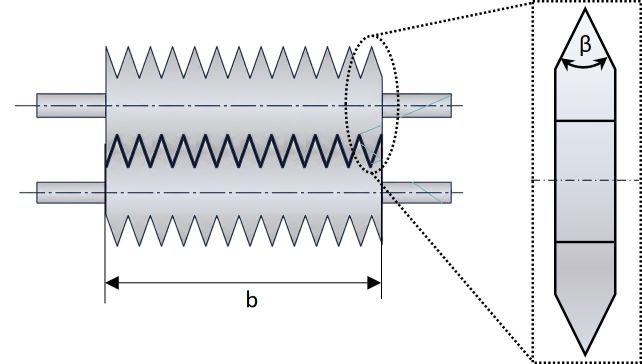
Consequently, a wedge-disc mill can achieve significantly higher throughputs with the same size of grinding mechanism.
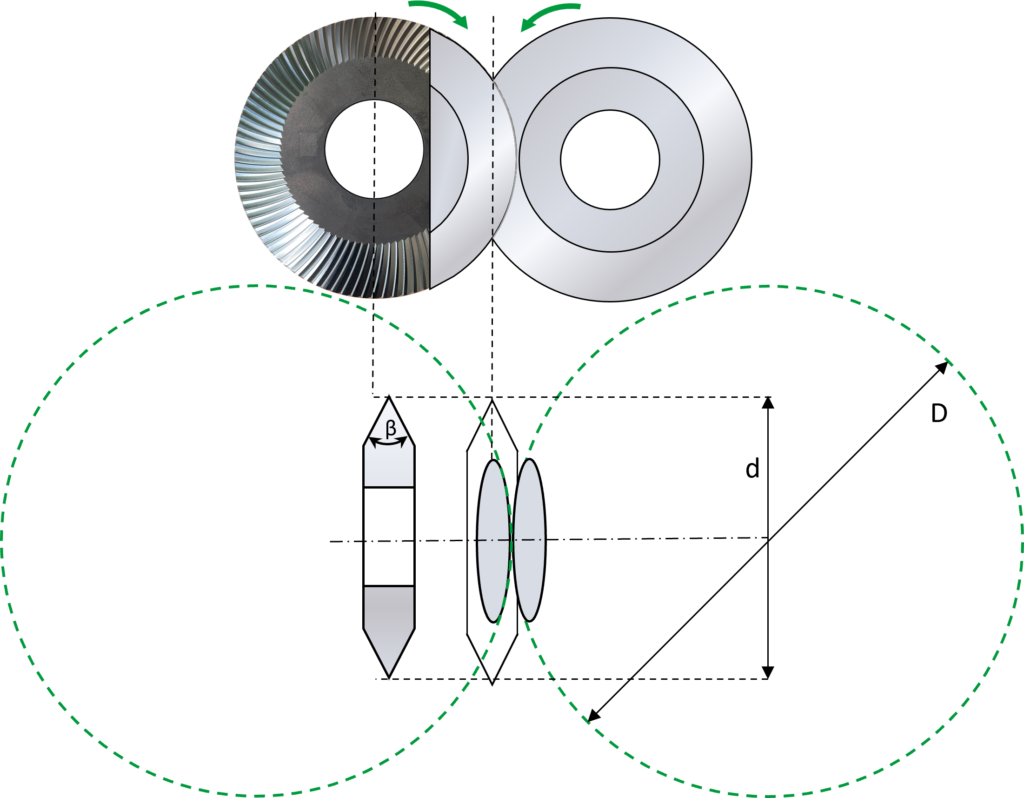
In a roller mill, the grinding process is directly influenced by the diameter of the cylindrical rollers. The larger the rollers, the better the material is drawn into the grinding gap. In a wedge-disc mill, the feed behavior is additionally influenced by the shape of the wedge discs and depends on the diameter of the wedge discs d and also on their wedge angle β. As a result of the geometric arrangement of the wedge discs, the effective diameter D varies slightly along the grinding gap and is significantly larger than the diameter d of the wedge discs themselves. The more acute the wedge angle, the larger the wedge discs appear for the grinding process.
A larger effective diameter means advantageous material feed behavior. This allows wedge-disc mills with smaller grinding tools to be used for the same application than it would be possible for roller mills. This means that MULTICRACKER® can be used flexibly even in compact sizes for small feed production systems.
The surface velocity of the grinding profile of a wedge disc rotating at a certain speed varies with the radius. At the cone tip on the outside, the velocity is highest; inside in the valley, it is lowest. Due to the arrangement of the counter-rotating wedge discs, the grinding gap is always created between the cone tip and the opposite cone valley. The result is a relative velocity of the opposing disc profiles. At the same rotational speed of both shafts, the relative velocity is greatest at the tips and exactly 0 in the middle.
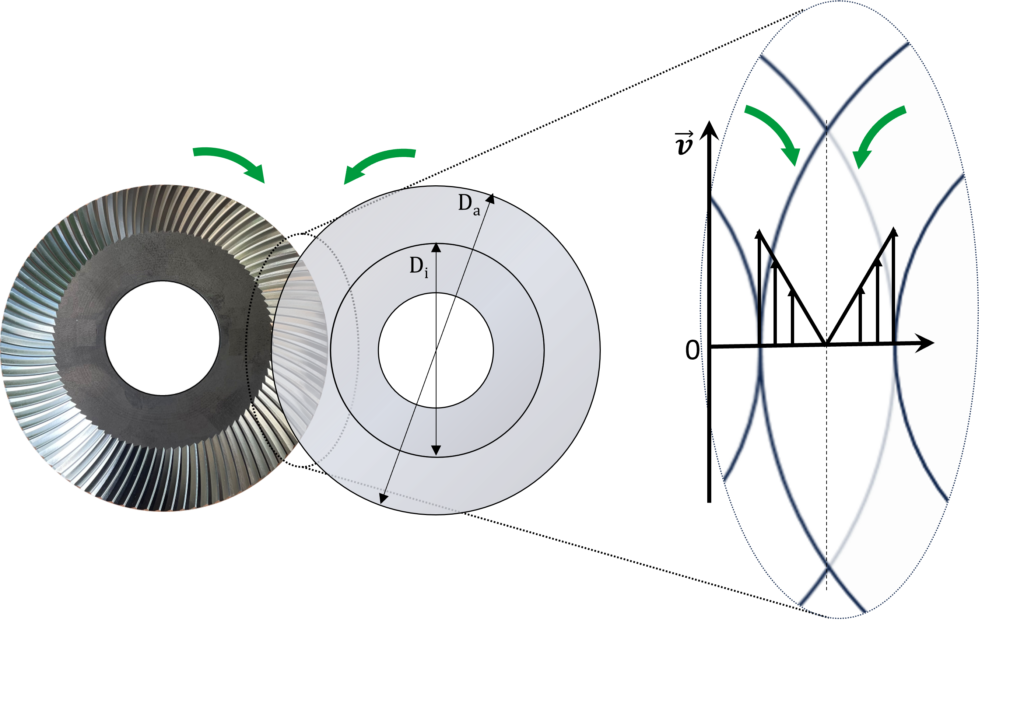
A positive aspect of this relative velocity is increased shear in the size reduction process.
The cracker discs are subject to high wear loads, especially during continuous operation. The special discs are therefore made of a particularly strong yet tough material. This makes them extremely wear-resistant and achieves high service life even in industrial applications. All cracker discs have a special surface profile for optimal size reduction results. This can be varied depending on the application. In addition to the three standard profiles – coarse, medium, and fine – special profiles are available for specialized applications and can be further customized upon request. On larger MULTICRACKER® machines, the cracker discs can be resharpened.
Yes, on industrial size reduction machines with disc diameters from 200 mm, worn cracker discs can be resharpened multiple times, which further increases the longevity of the grinding tools and ensures sustainable use of the material.
In a MULTICRACKER®, the ground material passes through the grinding gap in the shortest possible time and is ground with minimal heat input. Due to the short residence time in the machine, no significant heating occurs. Why is this aspect relevant?
In many application areas, material heating results in negative property changes. An example from the feed and food industry: Heat-sensitive vitamins such as vitamin C and vitamin B5 react sensitively to high temperatures. The same applies to vitamin B1 (thiamine), which is abundant in grain outer layers: It begins to degrade even with moderate heat exposure. So when it comes to preserving nutrients in grain, size reduction with MULTICRACKER® machines is advantageous